Singing the Bible
The Bible is not merely a collection of texts to be read; it is also a collection of truths to be sung with the heart. Central to the idea of singing the Bible is the traditional system of cantillation, or te'amim, which serves as a sophisticated map for musical phrasing, grammatical syntax, and theological emphasis. While most of the Tanakh follows a standard accentuation system, the three poetic books of Psalms, Proverbs, and Job, often referred to collectively by their Hebrew acronym as the Sifrei Emet (Books of Truth), employ a unique and more complex system of cantillation. Within these poetic structures, markers such as the Atnach (◌֑ - represented by the accent mark below the ◌) and Silluq (the mark under the final word, followed by the Soph Pasuq ׃) play a vital role, acting as the primary anchors for the rhythmic parallelism and melodic cadences that define biblical poetry.
When we talk about cantillation marks in the Hebrew Scriptures, in most cases, scholars are referring to the standard of vowels, pauses, and stresses that were developed in the 9th and 10th centuries, particularly in the Masoretic tradition. Many of these cantillation marks put stresses on ideas which remove ambiguities present in the consonantal text. One famous example of this type of ambiguity is in Isaiah 40:3 where the Masoretic text says, “A voice cries: ‘In the wilderness prepare the way of the Lord…’” (as reflected in the ESV) while the Septuagint says, “The voice of one crying in the wilderness: ‘Prepare the way of the Lord…’” (as reflected in the NKJV). Even without the Masoretic cantillation marks, the Hebrew of the Great Isaiah Scroll (1QIsa-a) of Isaiah 40:3 is often interpreted by the rules of Hebrew poetry to favor the Masoretic grouping. To preserve the parallelism of “in the wilderness” and “in the desert,” both prepositions must be inside the quotation to avoid breaking the structure of the poetry; however, there is no spacing in the original text to denote this. Because of the argument from parallelism, most modern translations render this, “A voice is calling, ‘In the wilderness, prepare the way for Yahweh…’” (as reflected in the LSB).
But wait! If modern translations (like the LSB and ESV) align with the Masoretic and Dead Sea Scrolls placement of the quotation marks in Isaiah 40:3, then why did the Holy Spirit inspire the Biblical authors to use the Septuagint's version of the text as in the gospel accounts (Matthew 3:3, Mark 1:3, Luke 3:4, John 1:23)?
This highlights how the Spirit's inspiration utilizes various linguistic traditions to unveil the full depth of His message. While the Hebrew text provides the structural and historical foundation, the New Testament’s embrace of the Greek phrasing underscores the purpose of the voice rather than its location. Far from being a contradiction, these variations invite us to look closer at different aspects of the same text.
The cantillation marks and markings in the Masoretic text are a more recent way of writing the phrasing preserved in the original Hebrew manuscripts of the Sifrei Emet. As we transition from the prose cantillation system used for the prophets to the poetic system of Psalms, Proverbs, and Job, we encounter a structure designed not just for reading, but for the profound resonance of worship. Far more than just being a 9th or 10th century commentary reflecting the Masoretic Jews' opinion of what the original authors meant, these jots and tittles preserve a rich depth of the Spirit speaking to our soul in a way that mere prose never can; nevertheless, we must balance these markings with caution, exercising due diligence to verify that these later, uninspired scribes correctly preserved the words and intent of the original, inspired Scripture.
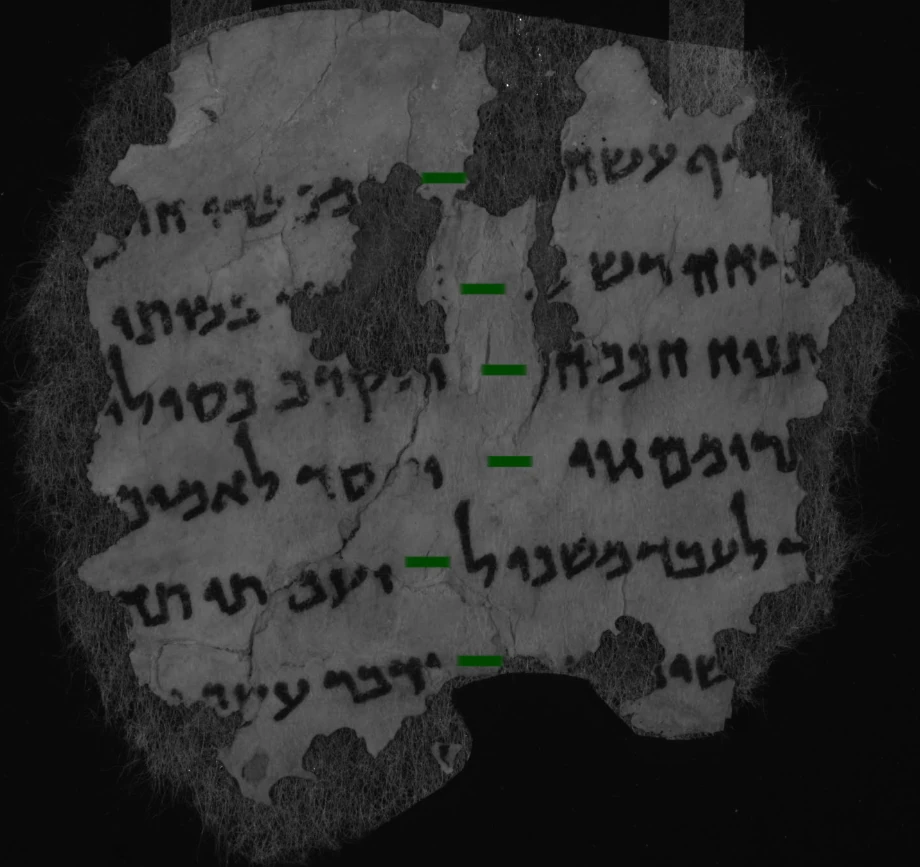 Fragment of 4Q103 (4QProvb) showing poetic spacing. The green lines are added to highlight the pauses. The bottommost green line is the one for Proverbs 15:1.
One of the most striking differences between the ancient manuscripts found at Qumran and the later Masoretic scripts, such as the famous Aleppo Codex, is how they handle poetic structure. In the earlier Dead Sea Scrolls, scribes often used physical space to denote the parallel members of a verse. For example, in the manuscript 4Q103 (also known as 4QProvb), we can see extended spaces within the text of Proverbs. By the time of the Masoretes, these physical gaps were often replaced with a sophisticated system of accents that served the same purpose but with added musical and grammatical detail. In Proverbs 15:1, the Masoretic text reads: מַֽעֲנֶה־רַּ֭ךְ יָשִׁ֣יב חֵמָ֑ה וּדְבַר־עֶ֝֗צֶב יַעֲלֶה־אָֽף׃ (“A gentle answer turns away wrath, But a harsh word stirs up anger”).
Fragment of 4Q103 (4QProvb) showing poetic spacing. The green lines are added to highlight the pauses. The bottommost green line is the one for Proverbs 15:1.
One of the most striking differences between the ancient manuscripts found at Qumran and the later Masoretic scripts, such as the famous Aleppo Codex, is how they handle poetic structure. In the earlier Dead Sea Scrolls, scribes often used physical space to denote the parallel members of a verse. For example, in the manuscript 4Q103 (also known as 4QProvb), we can see extended spaces within the text of Proverbs. By the time of the Masoretes, these physical gaps were often replaced with a sophisticated system of accents that served the same purpose but with added musical and grammatical detail. In Proverbs 15:1, the Masoretic text reads: מַֽעֲנֶה־רַּ֭ךְ יָשִׁ֣יב חֵמָ֑ה וּדְבַר־עֶ֝֗צֶב יַעֲלֶה־אָֽף׃ (“A gentle answer turns away wrath, But a harsh word stirs up anger”).
In this verse, the Atnach (the accent mark under the מָ֑ in חֵמָ֑ה) and the Soph Pasuq (׃) at the end of the proverb serve as the primary anchors of the poetic line. Interestingly, these Masoretic markers correspond directly to the extended spaces found in the 4QProvb fragment. Where the Qumran scribe left a void to signal a rhythmic pause or a transition in thought, the Masoretes “sing” that void into existence with the Atnach, transforming a silent gap into a melodic cadence. This evolution from physical space to musical accent demonstrates how the Books of Truth have always carried a heartbeat, whether expressed through the absence of ink or the presence of a song.
When you vocalize a Psalm like The Lord's My Shepherd or sing about a Proverb in songs like Angry Words, you're engaging in a sacred practice preserved in the pages of inspired Scripture and commanded by God. It's not that the translation or the music we sing is inspired, but the practice of making melody in our hearts with the Word of God certainly is!