The OpenPsalm Style Guide
Every score in the catalog follows one house style. Here's what the markings mean, with examples.
The shapes of the notes
Scores print with Aiken shape notes: every degree of the scale has its own notehead shape—do is a triangle, sol the familiar oval, la a rectangle, and so on. Once you find your starting shape, the intervals read at a glance. Every example below uses them; round noteheads remain available as an option on each song page.
Beams follow the words
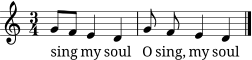
Notes are beamed together only when they share one syllable. If each note has its own syllable, the notes are flagged separately.
Longer runs get a slur
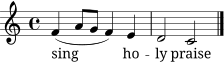
A run of notes on one syllable is a melisma. When the run includes a quarter note or longer, a beam can't cover it. A slur spans the whole group instead.
Tie, slur, or nothing?
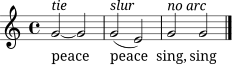
A tie joins two notes of the same pitch into one held sound. A slur joins different pitches on one syllable. Repeated pitches with no arc get a fresh syllable each.
The dashed slur
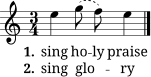
Sometimes the verses disagree: one verse puts a syllable on each note of a pair, another sings through them on one. A dashed slur means check your verse: if your verse has a syllable under each note, sing them separately; if it shows a gap, carry your syllable through.
The page stays simple
A few more rules keep the page easy to sight-read. The time signature is always spelled out in numbers—4/4, 6/4—never the old common-time “C.” Every measure is complete—a pickup sits at the end of a full first measure. Repeats are written out in full, so there are no repeat signs or endings to navigate mid-song. Line breaks follow the poetry. And in the standard SATB layout, markings that apply to everyone print once: dynamics above the top staff, fermatas once per staff, tempo changes (rit., a tempo) above the score.
These are similar to the conventions of traditional vocal engraving—the kind you'd find in a well-set hymnal from a century ago. A congregation sight-reads in real time, so every marking has to answer a question before the singer asks it. A page that answers quietly gets out of the way of worship.